
Market benchmarks gave up intra-day gains to close in the red for the sixth session on the trot on Friday, capping a bruising week which saw a massive dash for safety amid rate hikes by global central banks and fears of slowing growth.

These funds have lowered the entry barrier for investors who can now invest with just Rs 5,000, points out Sanjay Kumar Singh.

There has been a significant upsurge in the hiring activities as 52 per cent of companies are recruiting new staff at the moment, while 60 per cent are looking to do so in the near future.

Red Fort Capital, an international real estate fund founded by GB Singh, Parry Singh and Subhash Bedi, has invested nearly Rs 2,000 crore (Rs 20 billion) in the Indian real estate sector and claims that it is one of the few funds to have invested even in the downturn.

From the 30-share pack, Sun Pharma, TCS, Tech Mahindra, NTPC, Wipro, UltraTech Cement, Dr Reddy's Laboratories and Infosys were the major gainers, jumping up to 3.99 per cent. In contrast, Tata Steel, Nestle, Titan Company, PowerGrid, Reliance Industries Limited and State Bank of India were among the laggards.

HCL Tech was the top loser in the Sensex pack, skidding over 4 per cent, followed by Tech Mahindra Dr Reddy's, Wipro, TCS, Titan and Infosys. NSE Nifty plunged 167.80 points to 17,110.15.

ICICI Bank was the top gainer in the Sensex pack, jumping over 5 per cent, followed by Axis Bank, Nestle India, SBI, HDFC, ONGC and Kotak Bank. On the other hand, Bajaj Auto, TCS, Bharti Airtel, M&M and Maruti were among the laggards.

Equity benchmark Sensex rebounded 454 points on Thursday, boosted by gains in index heavyweight Reliance Industries amid a positive trend in global markets.

Currently, the US contributes 40-45 per cent of the total IT/ITeS outsourcing and offshoring business in India and is the single largest market for India's IT/ITeS business. The real estate sector's growth is fuelled by demand. In India, the demand is derived mainly through shift in global economic conditions. Thus any change in the real economy will have an impact on the physical real estate (construction or ready office space) market.

Equities went into a tailspin on Wednesday after the Reserve Bank surprised the market with a mid-cycle rate hike in a bid to tame soaring inflation.
Indian real estate industry, which is currently pegged at $16 billion, is witnessing increased interest from several international developers, primarily from the Middle-East, South-East Asia and Europe.

Although residential sales faced a major set back in Q2, they made a comeback with help of pent up demand.

In the quarter ended September 30, the Pirojsha Godrej-led firm recorded Rs 492 crore net sales, up 49% year-on-year

Tech Mahindra was the top loser in the Sensex pack, shedding over 3 per cent, followed by NTPC, IndusInd Bank, Kotak Bank and Reliance Industries. NSE Nifty fell 185.60 points to 17,671.65.

In one of the largest FDI deals in realty sector, global private equity Warburg Pincus will invest Rs 1,800 crore (Rs 18 billion) in Piramal Realty, which would use the funds to develop mixed-use projects in the megalopolis.

After years of living with his family in a poky 110 sq. ft. 'house', textile worker Sambhaji Surve dreams of moving into a home four times the size once the Maharashtra government starts its ambitious redevelopment of the 39-acre Kamathipura shanty town in south-central Mumbai. Sharing his dream are about 8,000 other families hoping for a better life when the redevelopment project, part of the government's effort to redevelop old settlements and make life more livable for some residents, gets underway. The Shiv Sena-Nationalist Congress Party aims to redevelop BDD Chawl and Dharavi but for Surve all the matters is Kamathipura where he arrived in the 1970s from Nasik to work in a textile mill. Kamathipura was originally built 150 years ago following construction of a causeway to connect the seven islands of Mumbai. From the British Raj to post-independence, it became infamous for slums and brothels.

ONGC was the top gainer in the Sensex pack, rallying around 6 per cent, followed by IndusInd Bank, L&T, UltraTech Cement, Titan, SBI and NTPC. NSE Nifty settled 32.10 points up at 14,707.80.
To begin with, Dawnay Day has entered into a joint venture with a Bangalore-based family to develop a mixed property development including office and retail on 16 acres with an investment of Rs 400 crore.

PowerGrid was the top gainer in the Sensex pack, rallying over 4 per cent, followed by NTPC, UltraTech Cement, Tech Mahindra, Reliance Industries and IndusInd Bank.

Amid slowdown, the company is buying quality land parcels at marquee locations across the country.

Major shareholder Kinnevik, a Swedish investment firm, devalued Quikr by 45%, referring to the exaggerated revenue resulting from fraudulent transactions that rocked the company. Quikr is now valued at about $577 million.

Urban planners and real estate experts say bad town planning in Mumbai and rising deaths during the ongoing pandemic are a "sad reality". Dev Chatterjee and Raghavendra Kamath report.

Consultants say at Rs 1,442 a sq ft, the developer has got a good bargain.

Bajaj Finance was the top gainer in the Sensex pack, soaring over 8 per cent, followed by Kotak Bank, IndusInd Bank, HDFC, PowerGrid, Axis Bank, ICICI Bank and L&T. On the other hand, Maruti, ITC, NTPC and Nestle India were among the laggards.

Stock market minnows put up a stellar show in 2021 giving returns of up to 60 per cent amid Dalal Street dream run and are likely to continue sailing northwards in the New Year too. Trumping pandemic-induced uncertainties, the Indian equity market posted stunning gains this year achieving several feats and smaller stocks benefited the most from the strong momentum. From reaching the momentous 50,000-mark in January to scaling 61,000-level in October, the BSE Sensex had an epic journey this year.

Tata Steel was the top loser in the Sensex pack, sinking over 5 per cent, followed by SBI, IndusInd Bank, Bajaj Finance, HDFC Bank and NTPC. NSE Nifty tanked 371 points to 16,614.20.
Asian Paints was the top loser in the Sensex pack, shedding 3.30 per cent, followed by Infosys, HCL Tech, ONGC, M&M, TCS, IndusInd Bank and L&T. On the other hand, ITC, Kotak Bank, Bajaj Finance, HUL and ICICI Bank were among the gainers, spurting up to 5.45 per cent.

ICICI Bank was the top gainer in the Sensex pack, rising around 3 per cent, followed by Axis Bank, HDFC twins, SBI, L&T, ONGC and Infosys. On the other hand, Sun Pharma, Asian Paints, Nestle India, UltraTech Cement and HUL declined. NSE Nifty rose by 79.60 points or 0.67 per cent to 11,914.20.
According to Cushman & Wakefield, the total value of investments in the residential segment for 2013 was recorded at Rs 4,050 crore ($650 million).
According to Cushman & Wakefield, the total value of investments in the residential segment for 2013 was recorded at Rs 4,050 crore ($650 million).

The NSE Nifty after shuttling between 10,397.60 and 10,279.35 points, ended 47 points, or 0.45 per cent lower at 10,301.05.

Bajaj Auto was the top laggard in the Sensex pack, tumbling around 6 per cent, followed by M&M, Reliance Industries (RIL), Tata Steel, Tech Mahindra, SBI, Axis Bank and ICICI Bank. NSE Nifty tumbled 162.60 points or 1.36 per cent to 11,767.75.

Infosys was the top gainer in the Sensex pack, rallying around 7 per cent, followed by TCS, IndusInd Bank, ONGC, HDFC Bank and HCL Tech. On the other hand, ITC, Bajaj Finance, Kotak Bank and Sun Pharma finished in the red.

Zinedine Zidane, Donald Trump, Steve Waugh have all lent their name to realty projects in the country.
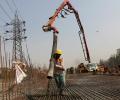
The key demand drivers -- such as low home loan rates and income tax sops, particularly for affordable housing -- that supported the recovery in H2 FY2021, remain in place and will spur recovery again, feel experts.
Mumbai is the 16th most expensive city for residential space.

Kotak Bank was the top laggard in the Sensex pack, shedding over 2 per cent, followed by ITC, PowerGrid, M&M, HDFC, Asian Paints and NTPC. On the other hand, Maruti rallied over 4 per cent. Bharti Airtel, Axis Bank, IndusInd Bank and Bajaj Finance were also among the gainers.

The senior RBI official, who assumed office on July 31, a day before he was to retire from the state-run Bank of Baroda as its chairman, said developments in construction technologies should make it possible for developers to bring down home prices.

